

Showing 641 - 660 of 803 results

Accelerator Operator
Role at ANSTO
Accelerator Operator.

Spatz - Neutron Reflectometer
A neutron reflectometer for vertical samples.
Distinguished Research Scientist
Role at ANSTO

Research Support Worker - Environmental
Elizabeth joined ANSTO at the beginning of 2024 and works as a Research Support Officer for Environment where she is involved in diverse research including ground water sampling and coral provenance.
Haemoglobin study sheds light on one of our bodies most important molecules
Predicting the impact of space radiation on satellite electrical systems
Airbus Australia Pacific has provided students participating in ANSTO’s National Graduate Innovation Forum with a practical challenge relating to technology that is exposed to damaging radiation in space.

Scientific Operations Group Leader
Role at ANSTO

Particle Induced X-ray Emission
Particle Induced X-ray Emission (PIXE) is a powerful and relatively simple analytical technique that can be used to identify and quantify trace elements typically ranging from aluminium to to uranium.
Sharing Sydney’s experience with South Australia
Two ANSTO scientists made an Officer of the Order of Australia

Water Isotope Network
Currently ANSTO partners with the Australian Bureau of Meteorology to operate the Australian GNIP stations with samples analysed at ANSTO’s Environmental Isotope Laboratories in Sydney.
Ancient groundwater enters food web
Ancient groundwater in Australia contributing carbon to food webs through surface water.
Advanced repair technology shows promise for rails in remote locations
3D cell printing technology earns ANSTO Eureka Prize for Technology
Researchers and industry partners from UNSW Australia, the Australian Centre for Nanomedicine, Children’s Cancer Institute and Inventia Life Sciences Pty Ltd have been awarded the 2021 ANSTO Eureka Prize for Innovative Use of Technology for their method to rapidly-produce 3D cell structures
Investigations of food authenticity
Use of nuclear techniques to benefit industry and consumers
Agreement with J-PARC opens neutron scattering conference
Soft x-ray spectroscopy
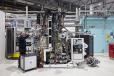
Soft x-rays are generally understood to be x-rays in the energy range 100-3,000 eV. They have insufficient energy to penetrate the beryllium window of a hard x-ray beamline but have energies higher than that of extreme ultraviolet light.

Instrument Scientist - Atmospheric Radon
Role at ANSTO
Engineering of atomic structure improves a promising cathode material for lithium-ion batteries
Researchers from the University of Wollongong have improved a high voltage cathode material to deliver structural stability and an unprecedented electrochemical performance for lithium-ion batteries (LIBs) in work that is extendable to other types of energy storage materials.