Non-invasive skin cancer treatment manufactured by ANSTO in Southern Sydney
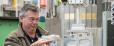
ANSTO has been licensed as the Australian manufacturing partner of an innovative, non-invasive treatment for non-melanoma skin cancer (NMSC).
Showing 61 - 80 of 319 results
ANSTO has been licensed as the Australian manufacturing partner of an innovative, non-invasive treatment for non-melanoma skin cancer (NMSC).
A large international research team led by Academia Sinica in Taiwan investigated how heat is transferred in an advanced thermoelectric material made with germanium (Ge) and tellurium (Te) and doped with antimony (Sb). These devices are used to power space probes such as the Mars Curiosity Rover.
Insights into the behaviour of structural materials in a molten salt environment
Specifications, Beryllium Filter, User Manual, Instrument reference
An international research collaboration between the University of New South Wales (UNSW), the Shanghai Institute of Applied Physics (SINAP) and ANSTO has provided insights into the performance of advanced material for use in the high-temperature environment of molten salt systems.
Dr Mitra Safavi Naeini continues her commentary of the radiation studies being undertaken in the Artemis II mission.
Director of the Australian Synchrotron Prof Andrew Peele has been appointed to Australian Mathematical Sciences Board.
Materials researchers focus on development, performance and in-service degradation of nickel-based superalloys, reinforced carbon-Carbon (C/C) composites, and ultra-high temperature ceramics (UHTC).
Material researchers at ANSTO use a range of in-house capabilities in the development, testing and characterisation of existing and emerging materials for extreme environments of the novel nuclear (fission/fusion) based energy-generation systems.
Neutron scattering instruments used by Japanese researchers.
Ultra small angle neutron scattering on Kookaburra is used to study the size and shape of objects of size 10 micrometres and below.
Recoil Time of Flight Spectrometry (RTOF) is used to detect a multitude of elements by separating their masses. unambiguously
Sample environments, Data analysis.
In partnership with the Australian Museum as part of National Science Week explore the 2020 hackathon theme of Deep Blue: Innovation for the future of our oceans
Sample environments, Data Analysis.